See the whole budget.
A worked example you can change. USD, 12 months, no tax or currency effects. These inputs are hypothetical, not a vendor quote.
Subscription + required add-ons + external setup
Cash budget + assumed internal time value, not another vendor bill
The useful number is not the advertised price
For a five-person team, a hypothetical $20-per-user plan becomes $1,200 a year before add-ons or setup. The worked example below reaches $1,500 in cash payments, or $1,740 including internal time. These are illustrative numbers, not a vendor quote.
Use this worksheet when two tools both seem affordable but have different seat rules, add-ons or contracts. You will leave with a comparable 12-month budget, not just a list of starting prices.
On this page
Define your buying scenario
See a five-person worked example
Copy the budget worksheet
Check billing and exit conditions
Make the decision
1. Define the same buying scenario
Write down the number of paid users, the workflow you need, essential integrations, expected usage, currency and whether tax is included. Use the lowest plan that actually meets those requirements for each candidate. A one-user entry tier is not equivalent to a five-user tier with required automation.
Keep three numbers distinct: the advertised monthly-equivalent rate, the amount charged on each invoice, and the total contractual commitment. Monthly invoicing can still sit inside an annual commitment.
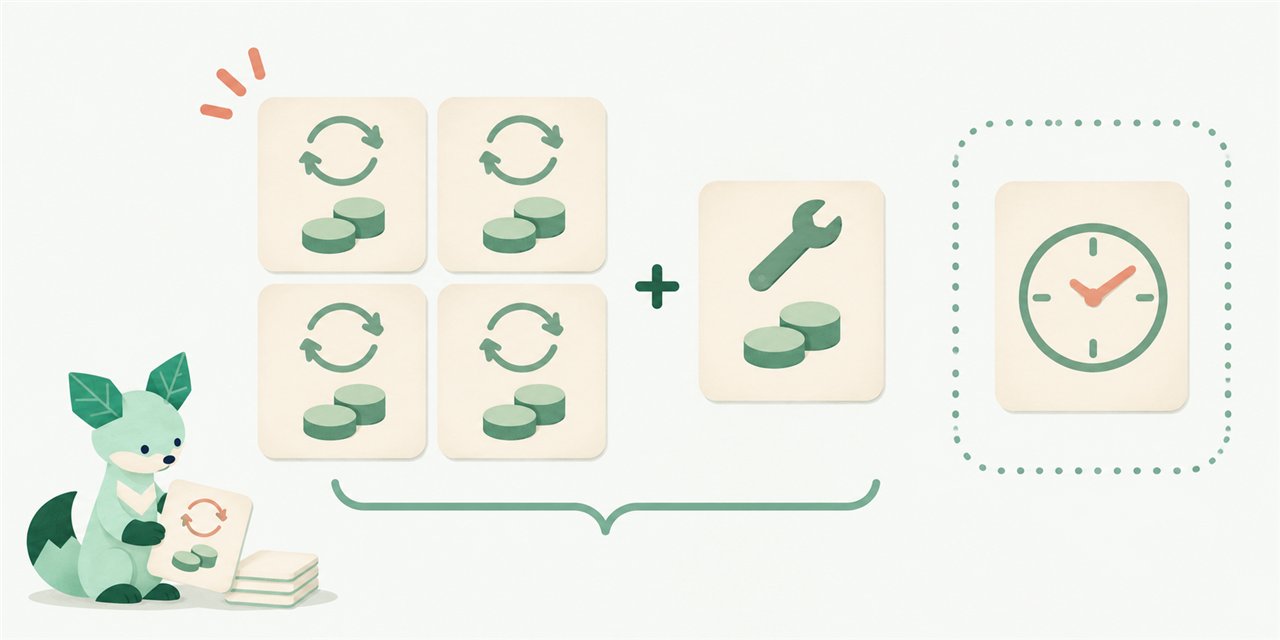
2. A five-person worked example
Assumptions: five users for 12 months, a $20 monthly-equivalent user rate, a required $10 monthly add-on, $180 external setup, and eight hours of internal setup valued at $30 per hour. All rates are hypothetical USD amounts. Taxes, currency effects and any unlisted charges are excluded.
| Component | Calculation | 12-month total |
|---|---|---|
| Subscription | $20 × 5 × 12 | $1,200 |
| Required add-on | $10 × 12 | $120 |
| External setup | One time | $180 |
| Cash budget | $1,200 + $120 + $180 | $1,500 |
| Internal setup time | 8 hours × $30 assumed value | $240 |
| Economic cost including time | $1,500 + $240 | $1,740 |
Do not count the same setup work twice. The $240 time value is not automatically another cash payment; it is a way to compare effort. Remove genuinely one-time costs for a renewal-year estimate, then recheck rates, seats and usage rather than copying year one.
3. Copy this budget worksheet
Copy the tab-separated rows below into a spreadsheet. Replace bracketed inputs with verified values. If a price is billed annually, put its actual annual charge in the annual column rather than multiplying an annual amount by 12.
Item	Monthly cash	One-time cash	Annual cash total
Subscription	[rate x seats]	0	[monthly x 12]
Required add-ons	[amount]	0	[monthly x 12]
External setup	0	[amount]	[one-time]

NON-CASH TIME VALUE (separate)
Activity	Hours	Assumed hourly value	Time value
Setup effort	[hours]	[rate]	[hours x rate]
Contract end	[date]
Cancellation notice deadline	[date]
The cash-cost formula
12-month cash cost = subscription charges + required usage and add-ons + external setup and migration. Keep internal time on a separate line. Only combine the two when you label the result as economic cost, not the vendor bill.
4. Check these conditions before trusting the total
- Seat rules: minimum seats, guests, contractors, and whether reducing active users also reduces the paid commitment.
- Usage rules: contacts, storage, records or automation units, plus the cost of exceeding them.
- Billing and cancellation: contract term, invoice frequency, renewal rate and notice window.
- Exit: export formats, ownership transfer, retention, migration work and access after cancellation.
These are not interchangeable across vendors. For example, Google Workspace’s official comparison distinguishes Flexible billing from an Annual/Fixed-Term commitment and says annual licenses can be reduced only at renewal. That is a contract example, not a rule for every SaaS product.
5. Decide with a cost range, not a false promise
Calculate a base case and a busy-month case. If usage doubles or one contractor needs a paid seat, does your preferred option still fit the budget? Mark uncertain charges as “not verified” rather than assuming zero.
Treat expected time savings separately. An assumed two hours saved at an assumed $30 per hour represents $60 of potential capacity, not demonstrated revenue or cash savings. Include maintenance and exceptions before claiming a return.
Your next action
Complete one worksheet per shortlisted tool using the same team and workflow. Resolve the two largest unknowns with the vendor before starting an annual commitment.
Method: original decision framework with hypothetical calculations. No achieved savings, live vendor quote or product test is implied.
Sources and research notes
Checked November 3, 2026 (Asia/Seoul). AI-assisted research and drafting, with source and arithmetic checks. Documentation-based analysis, not hands-on product testing. Recheck vendor terms before purchase.